
Values Shown in Iowa County Property Records
An assessment entry in Iowa County typically splits total assessed value between land and improvements. It also carries a year, a property class, and any exemption details. A deed index answers a different question. It shows what consideration or transfer details were recorded when ownership changed hands. Keep those figures separate. Assessment values exist to support the local levy and the tax calculation. A recorded sale is one observed transaction under its own conditions. Assessors may lean on comparable sales and property characteristics to estimate full value. Even so, the public screen remains an assessment record. It is not a negotiated offer or a lender's appraisal.
| Value | What It Is | Where |
|---|---|---|
| Assessed value | The assessor's value for the assessment year, used in the tax process. | Iowa County assessment search |
| Market / full value | The assessor's estimate of market value under the assessment method; it may be represented through the assessed figure and level of assessment. | Assessor records and Wisconsin DOR ratio reports |
| Last sale price | Transfer consideration associated with a recorded deed, when available and verified. | Register of Deeds index and assessment record |
| Land vs improvement | Separate allocation for the parcel's land and buildings or other improvements. | Iowa County assessment search |
Wisconsin puts assessed value side by side with estimated market value. It does this through a level of assessment. The math is simple: assessed value divided by market value. The Department of Revenue's sample ratio material offers an example. A $140,000 assessment against $150,000 in market value works out to about 93 percent. That arithmetic describes a ratio. It is not a discount a buyer can claim. Assessment and sale figures can diverge because of timing or property condition. Non-market transfer circumstances play a role too. So does where the assessor sits in the valuation cycle.
Looking Up Iowa County Property Values
Begin with the Iowa County assessment search. Try the situs address or the parcel identifier. The county's Tax / Assessment Record Search portal serves as the entry point, and its fields and display labels may vary by visit. Once a record opens, note the assessment year. Separate the land, improvement, total value, exemption, and sale fields rather than treating them as a single number.
- Open the Iowa County Tax / Assessment Record Search and try a street address or parcel identifier. The county's portal was not available to automated research, so exact field labels and current search behavior should be confirmed on the live page.
- Read the assessment year and distinguish the land, improvement, and total figures; record exemptions or class labels separately.
- Use the deed index to locate the last transfer and confirm the instrument rather than treating an assessment screen's sale field as conclusive.
- Compare only similar properties and dates. If the assessor portal offers neighborhood or comparable-sale material, verify its method and include condition and parcel changes in your review.
- Assessed value
- The assessor's assigned value for a parcel in a named assessment year, used in the local property-tax calculation.
- Market / appraised value
- A market value is an estimate of what a property might sell for under defined conditions. An appraisal is an independent professional opinion prepared for a particular assignment; it is not interchangeable with the assessor's mass appraisal.
- Level of assessment
- The relationship between aggregate assessed values and estimated market values. A sales ratio study evaluates that relationship; an individual ratio alone does not establish that one parcel is incorrectly assessed.
How Wisconsin Assessment Ratios Put Values in Context
The Wisconsin Department of Revenue runs sales-ratio analysis. It compares assessments with qualifying real-estate transfer returns. A transfer return records transaction information used in state and local sales studies. Some sales never make the cut. Transactions that do not reflect ordinary market conditions may be excluded from a given analysis, which makes the ratio study a population-level tool rather than a list of every sale. The DOR's published example shows why assessment and sale amounts should be compared using a stated year and a defined sample. The Wisconsin Department of Revenue sales-ratio analysis serves as a reference for the ratio method. It is not an Iowa County parcel valuation. It also does not show that any named home's assessment is too high or too low.
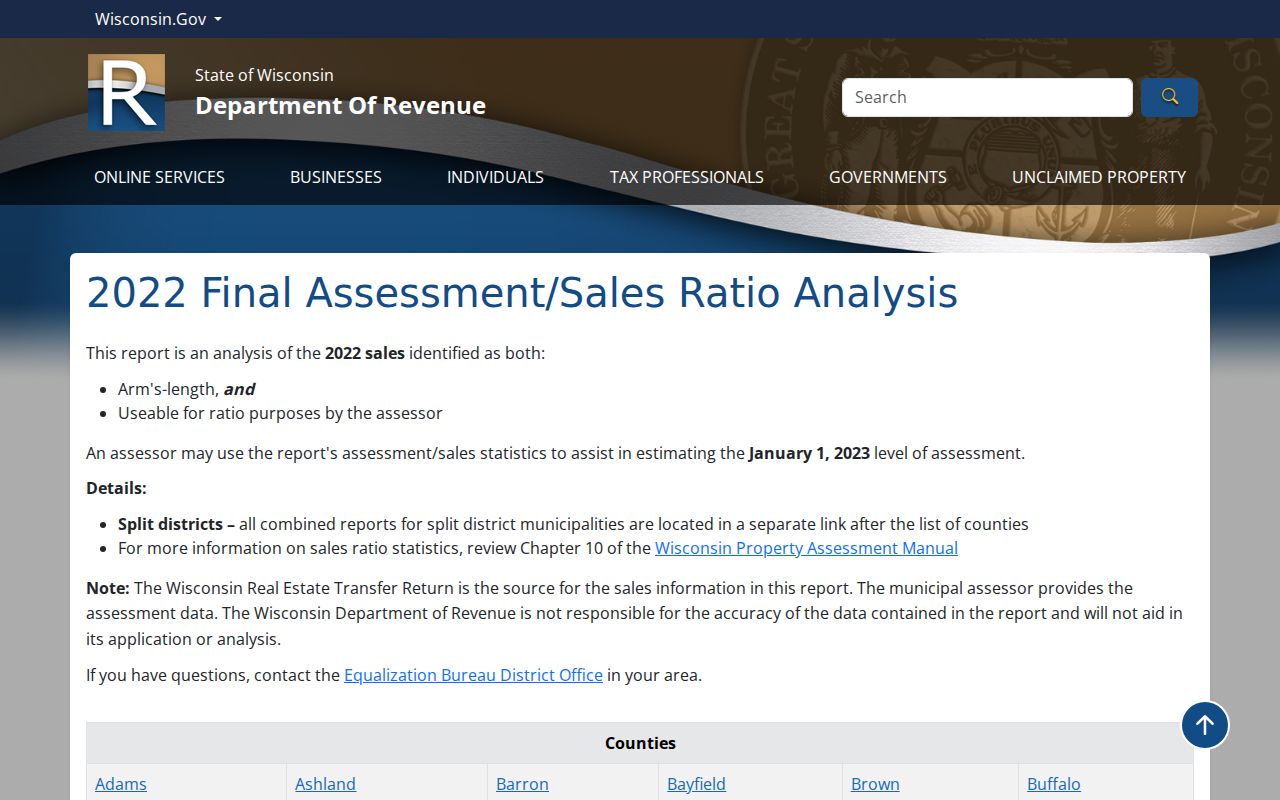
Treat ratio information as context, not a verdict. Then ask the assessor which parcel facts, comparable sales, and assessment year informed that property's figure.
Why a Parcel's Recorded Value Can Change
Assessment records change as property changes and as local valuation work proceeds. New construction, remodeling, demolition, parcel splits, combinations, and corrections all occur. Each can affect the description or allocation of value. The annual tax process adds another layer. It combines the assessed roll with local levies and credits. So a bill can shift even when an assessment barely moves. Any year-to-year comparison should note both the parcel facts and the assessment year.
Iowa County publishes no current countywide revaluation schedule. No recent countywide reassessment announcement appears in county materials. Do not infer one from a single property's change. If a value seems inconsistent, ask the assessor whether the property record, physical characteristics, or valuation inputs changed. Ask also what review process applies for that assessment year.
Construction and remodeling shift the improvement component. A parcel split or combination changes how land is grouped. Even a corrected address can affect the card. A corrected physical description can too, while the market stays stable. Keep building-permit information, survey maps, and the assessment year beside any value comparison. That keeps the property being measured clear.
Use Recorded Sales Carefully
A deed record proves a transfer happened. It rarely shows the full economics behind it. Sales between relatives, gifts, foreclosures, parcel splits, and multi-parcel conveyances all behave differently. None matches an ordinary arm's-length sale of one home. Some deed instruments state the consideration paid. Others require transfer forms or supporting records before the numbers make sense.
Start with the parcel number and legal description. Pin down the transfer date and instrument, and confirm the sale covered only that parcel. From there, weigh property type, size, condition, and location against the home you care about. Check the timing too. The property-tax guide shows how assessed value drives the bill. The property search guide walks through the county assessment portal's role in the lookup.
A ratio study groups many sales to judge assessments across the board. It cannot settle a one-parcel dispute by itself. Any value review should stick to properties with similar use, physical features, and valuation dates. It should filter out non-market conveyances that sit in the deed index. An assessor card may list a sale date. Confirm the transfer document. Confirm any related parcel change before treating that price as a comparison.
What an Iowa County Assessor Value Cannot Tell You
An assessor's value exists to spread the tax burden fairly, not to price a sale. Because it comes from mass appraisal, it can trail a fast-moving market. It can also blur the differences between individual properties. The recorded condition and characteristics of the parcel also shape it. So it cannot promise what a buyer will offer, what a seller will net, or what a lender will lend against the property. It cannot promise that. A licensed appraiser looks at one specific property for a defined purpose and date.
Value vs. price. An Iowa County assessment is a tax-roll figure, not a sale appraisal or offer. For a purchase, refinance, estate, or other decision requiring a supported current value, consult a qualified appraiser and verify the underlying parcel facts with the assessor.
Wisconsin's sales-ratio report separates two different numbers. One is the ratio for an individual parcel. The other is a municipality's overall assessment level. DOR's example of a $140,000 assessment against a $150,000 sale works out to roughly 93 percent for that parcel. Its separate $2.7 million assessed against $3 million equalized example describes a 90 percent municipal level. Neither example measures Iowa County. Keeping the distinction straight prevents a mistake. It stops a statewide method illustration or municipal statistic from being mistaken for a finding about one home.
The same math explains something useful. An assessment can sit above or below a single sale without signaling an error. A ratio means little without its valuation date, property category, and sales sample. The Department of Revenue study draws on transfer-return data. It excludes transactions that do not reflect market value from some analyses. Ask whether a given sale is truly comparable before leaning on it. Keep a market appraisal separate from the public assessment that drives the tax process.